
Conventional battery recycling can recover valuable elements, but it often loses the engineering already invested in producing the electrode active materials. Cathode and anode materials are typically converted into metals, salts or black mass (which can account for around 40–50% of an EV battery’s total weight) before undergoing further chemical and thermal processing to be reintroduced into cell production. This makes the recycling pathway lengthy, complex and resource-intensive. It therefore raises an important question: can battery recycling be made shorter and more sustainable while remaining economically viable?
The September 2026 issue of the Green Sustainability Magazine explores the answer to this question with CellCircle, ReUse’s project partner. Dr Andreas Bittner, the founder and CEO of CellCircle, explains the potential of a shorter recycling route for battery recycling sustainability, estimating the impact of CellCircle’s approach to 85% lower emissions within the cam-production stages.
CellCircle aims to preserve and regenerate active materials wherever possible, rather than breaking them down into their elemental constituents via pyrometallurgical or hydrometallurgical routes. The process involves dismantling battery cells, separating functional components and removing impurities to recover materials suitable for further use. Target products include cathode materials such as nickel-manganese-cobalt oxide (NMC) and lithium iron phosphate (LFP), as well as graphite and conductive carbon.
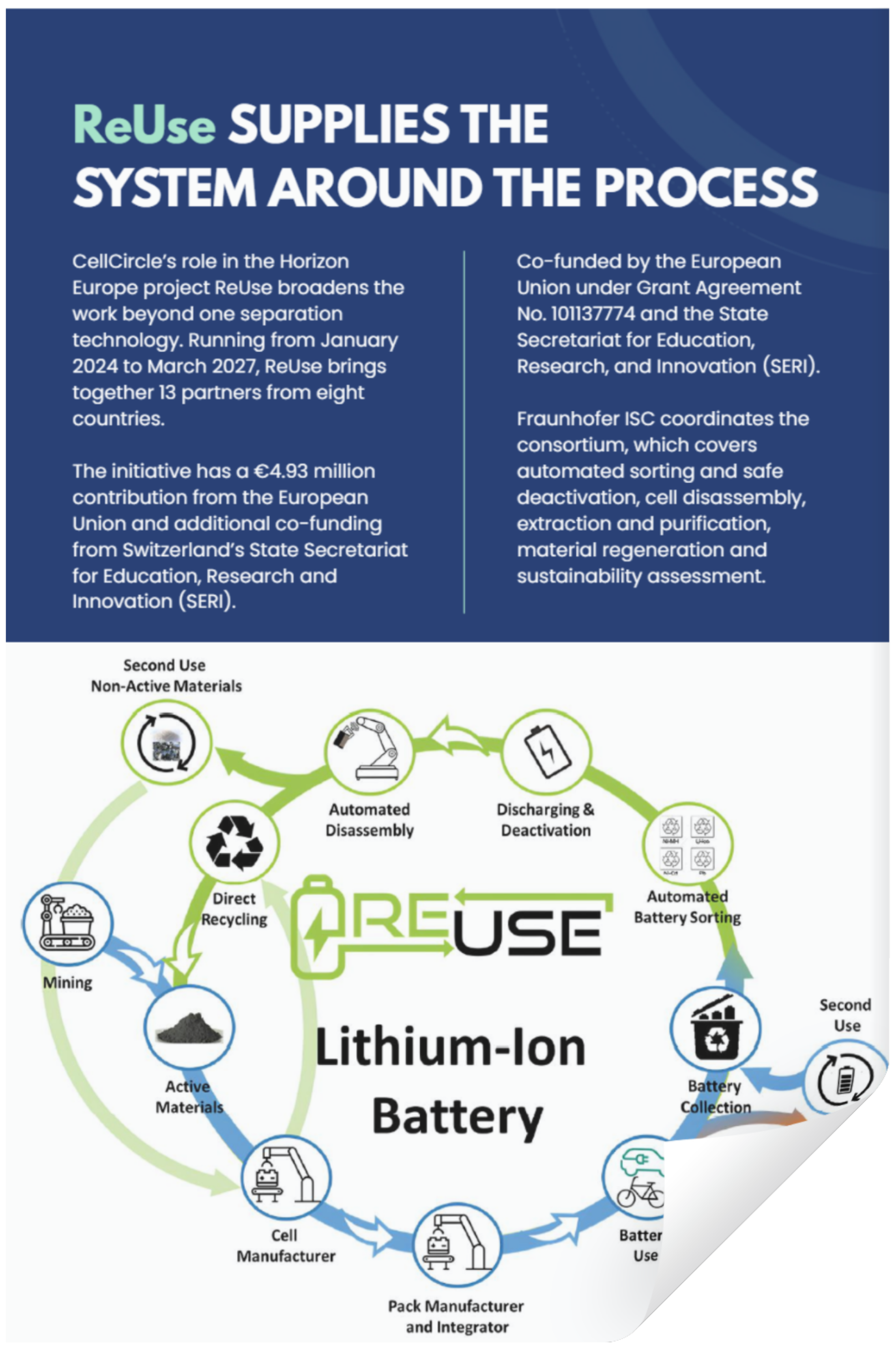
CellCircle’s direct-recycling approach is particularly relevant for LFP batteries, which account for nearly half of the global electric-car battery market according to the IEA. By preserving and regenerating usable LFP active material instead of high-value metals, direct recycling offers a way to retain more of the material’s existing manufactured value.
In terms of economic viability, CellCircle sees potential in integrating recycling more closely into both manufacturing economics and waste management. Rather than transporting battery waste to centralised metallurgical hubs, the company aims to establish modular recycling facilities close to cell-production sites, allowing recovered materials to return directly to manufacturing while reducing transport, handling and associated costs.
ReUse aligns CellCircle’s approach with the overarching challenge of closing the loop for LFP batteries. This project fosters a collaborative environment focused on advancing this approach specifically for LFP batteries and production scrap. By uniting expertise in sorting, disassembly, material regeneration, and sustainability assessment, ReUse explores how functional battery materials can be retained and reintegrated into production with reduced processing steps.
