
Lithium iron phosphate (LFP) batteries are rapidly gaining ground in Europe, particularly in stationary energy storage and mass-market electric vehicles. Their thermal stability, long cycle life and cobalt-free chemistry make them an attractive option — but their growing success is creating a new challenge: how to recycle them efficiently at end of life.
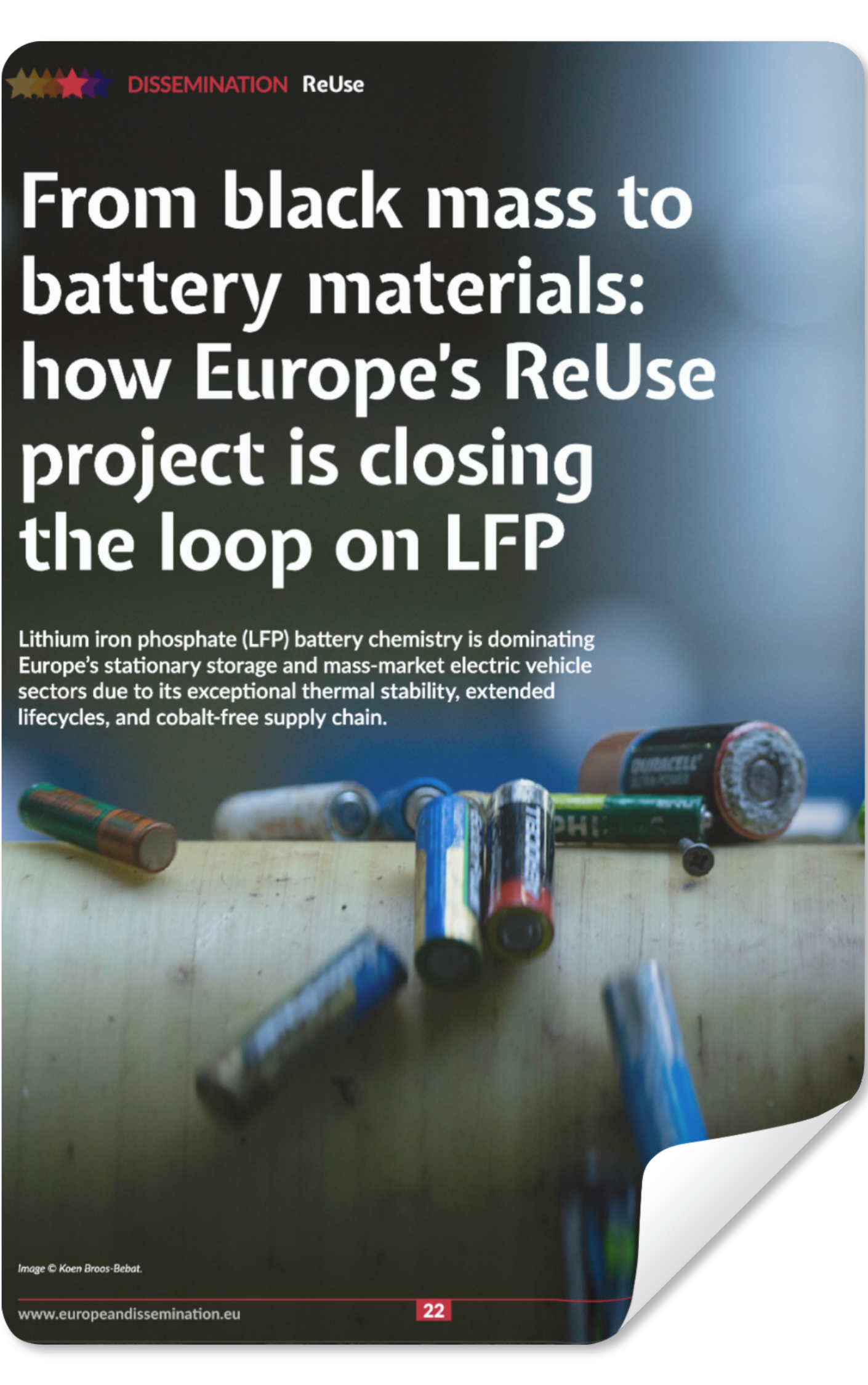
A new article featuring the ReUse project explores this challenge in the latest edition of the Project Repository Journal by EDMA. The article was drafted by Aleksandra Roganovic from ElevenEs, with support from our coordinator and FENIX TNT, and looks at why conventional recycling approaches are not necessarily suited to the growing volumes of LFP battery waste.
Much of today’s battery recycling infrastructure was developed around high-nickel chemistries such as nickel manganese cobalt (NMC), where the value of recovered metals can help offset the cost of intensive recycling processes. LFP batteries, by contrast, rely on relatively low-cost materials such as iron and phosphate, making conventional recycling routes less economically attractive.
At the same time, recycling LFP cells presents several technical challenges. Shredding produces black mass containing LFP, carbon black and graphite, while conventional processing routes can result in the loss of valuable lithium or treat graphite as an unwanted impurity. PVDF binders can also complicate material separation and downstream processing.
With large volumes of both battery production scrap and end-of-life cells expected to enter the waste stream, developing recycling approaches specifically suited to LFP is becoming increasingly important.
This is where ReUse comes in. Rather than treating the different components of an LFP battery simply as waste, ReUse is investigating how materials including cathode and anode active materials, conductive carbon and binders can be recovered and regenerated. Combined with improved sorting, disassembly and material separation, these approaches aim to improve resource efficiency and help close material loops within the European battery value chain. The new publication provides a closer look at the challenges behind this work and the need for recycling technologies capable of keeping pace with the rapid growth of LFP batteries.
The same issue also features BATMASS, one of ReUse’s sister projects. BATMASS aims to establish an EU Circular Battery Valley by connecting regions, research organisations and SMEs to scale up, commercialise and deploy innovative battery technologies across Europe. Together, the two project features highlight the growing range of approaches being developed across the European battery research and innovation community to address the challenges of battery recycling.